How to Find My Family Crest (Without Falling for Fakes)
By Burtay Eray Dinçel ·
Short answer: You cannot look up a family crest by surname, because real coats of arms are granted to individuals and passed to their proven descendants. To find one, trace your family tree back to an ancestor who bore arms, then check the heraldic authority for that country. If there is none, you can design your own.
Why a surname alone will not find your family crest
Anyone asking how to find my family crest tends to start by typing a surname, and that is the move that fails. Arms are personal. The ScotlandsPeople guide to coats of arms puts it plainly: there is no single coat of arms which all people of the same name can use. Having the surname gives you no right to a design, and a surname can be shared by families with no connection to each other.
FamilySearch makes a similar point from the genealogy side. A matching last name does not prove a family link, and it notes that crests were mostly held by nobility or well-off families in medieval Europe, so they are rarer than people expect. Many families will not find an old crest waiting for them.
How to find my family crest, step by step
The honest route is slow because it runs through your own ancestors. Work in this order.
- Build your family tree back as far as records allow, with names, places and dates, and note the country each line came from.
- Look for an ancestor who is documented as bearing arms. A surname match on a website is only a lead, not evidence.
- Ask the heraldic authority for that country whether arms were granted or recorded to that ancestor (see the table below).
- Prove descent from that person with birth, marriage and death records. Scotland, for example, asks for exactly this before it will matriculate an ancestor's arms.
- Record what you find: the blazon (the written description), the date, and who held the arms.
If the trail goes cold, a professional genealogist can pick it up from there. What you are after is a documented line from you to a named bearer.
Which heraldic authority to check
Each country keeps its own records, so start with where your ancestor lived.
| Where the ancestor lived | Who to ask | What to know |
|---|---|---|
| England, Wales, Northern Ireland | The College of Arms, London | The Court of the Lord Lyon directs people domiciled in these places to the College of Arms. |
| Scotland | The Court of the Lord Lyon | Descendants of a same-named grantee can apply to matriculate, but must prove their relationship to the original grantee. Recorded arms are protected under Scottish law. |
| Republic of Ireland | Office of the Chief Herald of Ireland, National Library of Ireland | The office is not accepting new applications for grants or confirmations of arms until further notice. Its manuscripts can be viewed in the library's reading room. |
Two cautions. Scotland's rules for new grants turn on birth or domicile in Scotland, and the Lord Lyon states that it is not generally possible for non-British citizens to be granted Scottish arms. The mygov.scot application page says applicants should be born in Scotland or settled there. The mygov.scot page adds that if you live elsewhere you may still apply for arms in the name of an ancestor who lived in Scotland, with proof of the ancestry. And a grant is not automatic: the ScotlandsPeople guide notes there is no statutory right to a coat of arms. For most American families, the practical step is to find which country the bearing ancestor came from and ask that country's office.
How to spot a fake surname crest
A page that returns a shield the moment you type your last name is selling a generic design. Since there is no single coat of arms that everyone of that name can use, a surname search cannot tell you which one, if any, is yours.
Watch for these signs:
- The result depends only on your surname, with no questions about your ancestors.
- The site promises a finished crest within a day, with no research step.
- There is no named original bearer, date or record.
- The word "crest" is used for the whole design. A crest is only the element above the helmet, and the shield is the one required part of a coat of arms, as FamilySearch explains.
A printed surname design is fine as decoration. It is not proof of lineage.
What to do if there is no crest for your family
You can design your own. FamilySearch suggests basing it on your family's achievements and stories, and recording the image and what each part means so later generations understand it. A personal emblem might use a shield shape, an animal or plant tied to a place your family lived, your initials, or a motto.
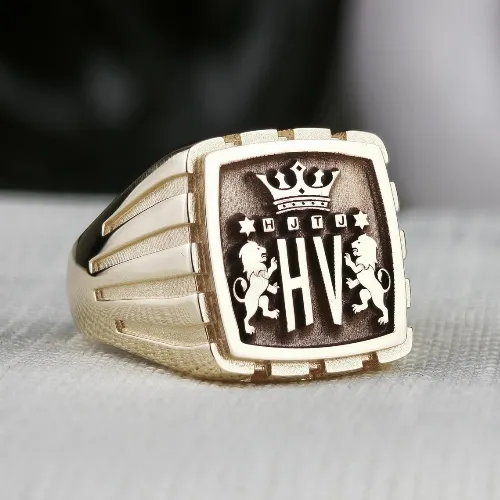
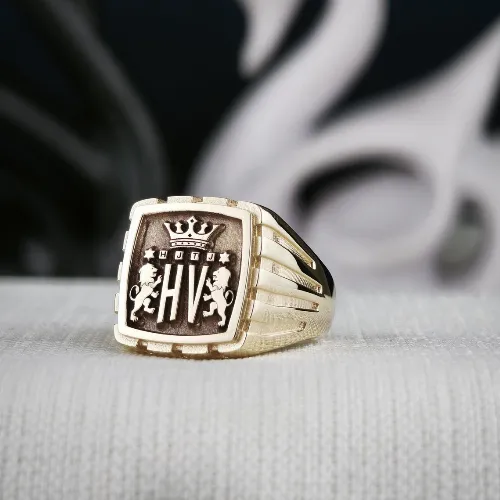
People also choose a monogram or a simple symbol instead of heraldry. Both work well on a signet. Our guide to choosing a family crest ring goes through shapes and metals.
How a crest becomes a ring
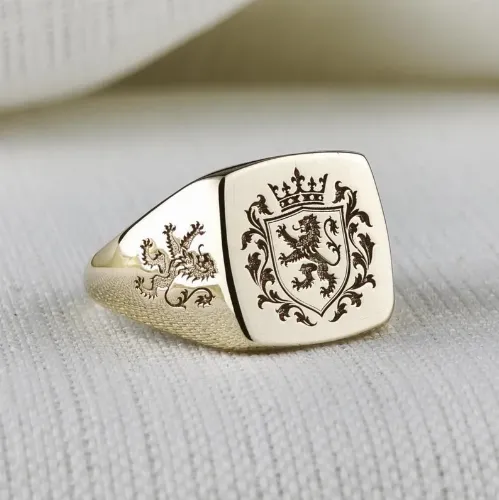
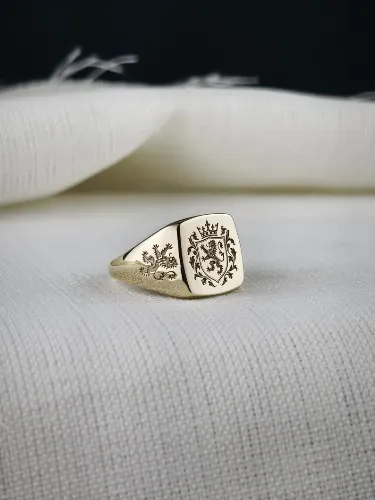
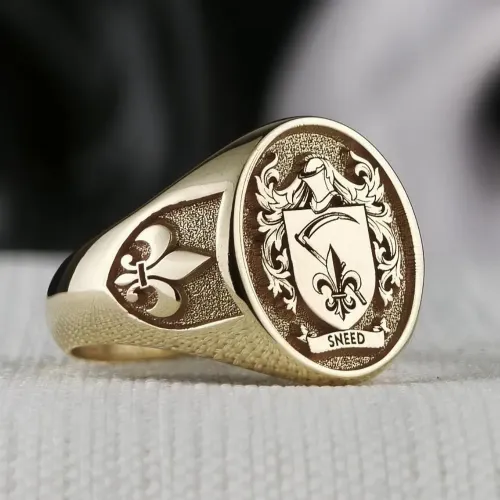
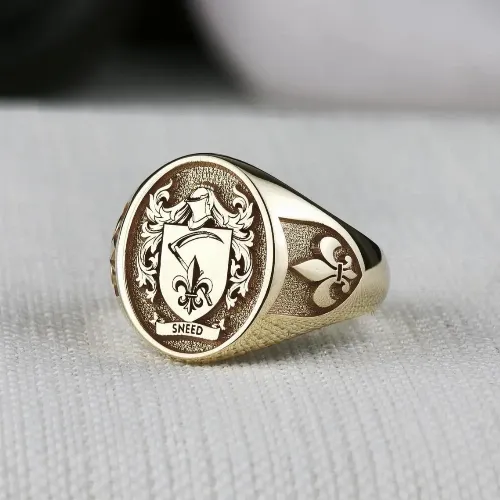
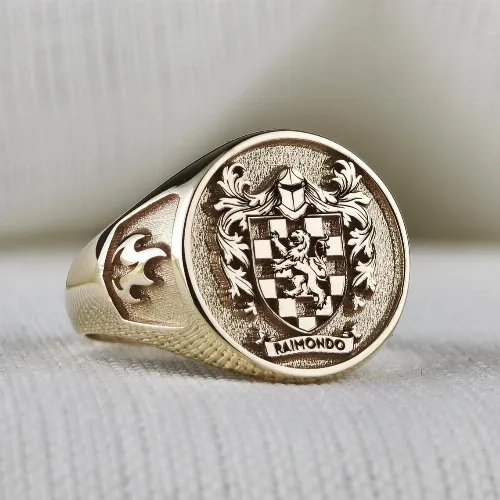
We make signet rings from artwork you send. We do not look up arms, confirm entitlement, or tell you whose crest is whose. If you have an inherited design, a photo of a seal, or your own sketch, you upload it on the product page and we adapt it to the ring face. The digital proof shows how the lines and lettering sit at ring size. We send it within 24 to 48 hours for your approval, and production starts after you sign off.
After approval, the workshop takes about 2 business days. Delivery is 5 to 7 business days, free and tracked, with duties covered on US orders. Browse the family crest rings, see the custom rings if your design is a personal one, or read how personalization works before you upload anything.
Frequently asked questions
Can I find my family crest for free?
You can start free by building a family tree and checking armorial references, but a free surname match does not prove a link. FamilySearch warns a matching last name is not evidence. Real confirmation comes from an authority's records plus documents proving your descent.
What is the difference between a crest and a coat of arms?
A coat of arms is the full design, usually a shield with helmet, wreath, mantling and motto. The crest is one smaller element above the helmet. Many people use the word crest for the whole thing, which is why searches mix the two.
Is it legal to wear a ring with a crest that is not mine?
Rules differ by country. ScotlandsPeople says arms cannot be used legally in Scotland unless recorded in the Lyon Register. We make no claims about entitlement: we engrave artwork you supply and are entitled to use, so check the relevant authority if you are unsure.
Can you make a ring from a crest I designed myself?
Yes. Upload a sketch, image or description on the product page and we adapt it to the ring face. You approve a digital proof before production, so you can request changes to lines, lettering or proportions before anything is cast.
How long does a family crest ring take to arrive?
Production takes about 2 business days after you approve the design proof, then delivery takes 5 to 7 business days with free tracked shipping. Order early and message the studio if you have a deadline, because we do not promise delivery by a specific date.
Keep reading
- Gift for Dad Who Has Everything: Honest Ideas Compared
- How to Choose the Perfect Family Crest Ring: A Complete Guide
- Christmas Gifts for Boyfriend Jewelry: Rings and Pendants
Shop the collection: Family Crest Rings.