Coat of Arms and Family Crest Rings: The Real Story
By Burtay Eray Dinçel ·
A coat of arms belongs to a person and their descendants, not to a surname, and knowing this helps you choose a family crest ring you can be proud of.
Where coats of arms began
Western heraldry developed in the 12th century. Britannica describes the earliest firm evidence as an enamel made not earlier than 1151, showing Geoffrey IV of Anjou with a blue shield carrying golden lions. Seals bearing heraldic devices from as early as 1136 survive. Knights used arms to show opponents, and allies, exactly who was behind the armor. By the 13th century the practice had spread to nobles and knights, and later to towns, guilds and universities. From the 15th century, heralds in colleges of arms settled disputes and checked claims to arms.
Seals matter for our story. Early heraldry is traced mainly through seals, and seals were pressed into wax by signet rings. That is why a crest on a signet ring is not a modern invention: it is the original use.
The signet itself is far older than heraldry. The Metropolitan Museum of Art holds a gold signet ring with Tutankhamun’s throne name, from about 1328–1318 BCE, and notes that it shows wear from frequent use as a seal. European coats of arms added their own identity marks to that very old tool.
One caution on dates: a chronicle written around 1170 describes Geoffrey of Anjou’s 1128 knighting and a shield with golden lions, but it looks back about forty years, so 1128 should not be read as the exact date of the first coat of arms. The enamel plaque is the firmer evidence, and it was made after his death in 1151.
The parts of a coat of arms
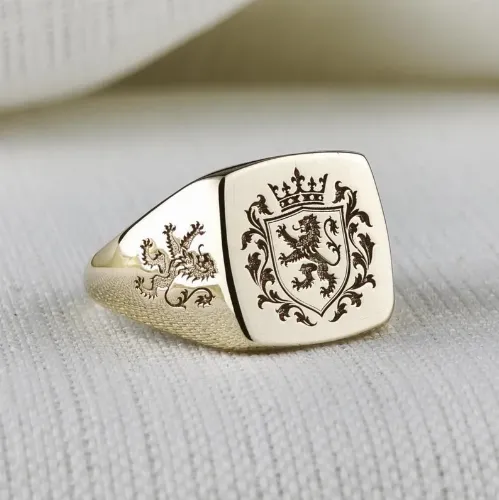
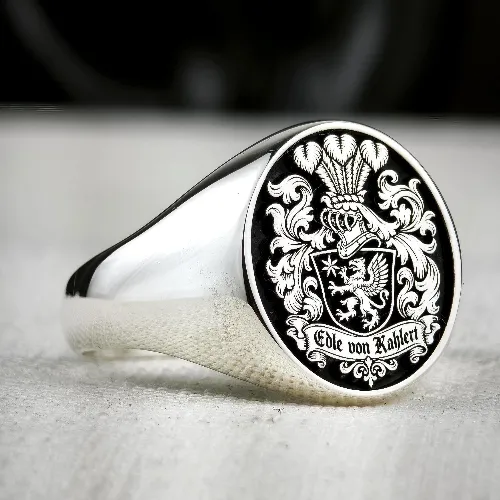
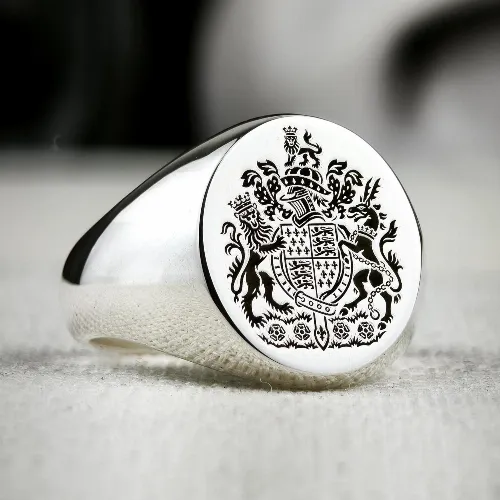
- Shield: the central design, with colors and symbols such as lions.
- Helmet and crest: the crest sits above the helmet. It is only one part of the whole.
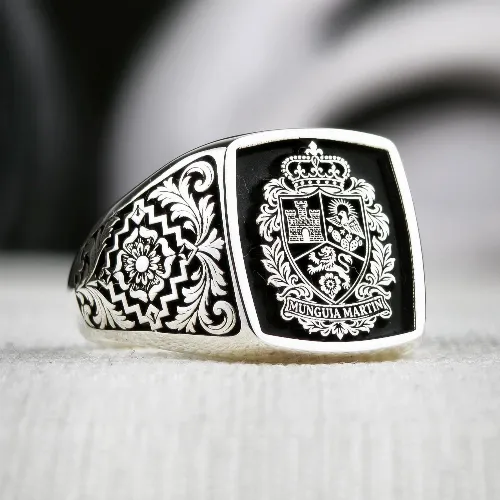
- Motto: a phrase, often in Latin, that sits with the arms.
People often say family crest when they mean the whole coat of arms. In everyday talk that is fine, but in heraldry the crest is just the figure above the helmet.
The big myth: there is no coat of arms for a surname
The Heraldry Society states that a person’s surname is not directly connected with their coat of arms. There is no coat of arms for Smith, Jones or any other surname. Arms were granted to individuals, and descendants inherit them through a documented line of descent. Two people with the same surname and no common ancestor have no shared claim.
This is why a printout from a surname website usually only shows that, somewhere, someone with your surname once had arms. It does not show that you do. Descendants also changed the design: the Vancouver Public Library notes that an eldest son adds a difference mark called a label to his father’s arms, and other sons add other standard marks.
So what can you put on a signet ring?
- Your real arms. If you can document descent from the person who bore them, you can engrave them. The College of Arms in England, the Court of the Lord Lyon in Scotland and similar bodies keep records.
- New arms. The College of Arms can still make new grants today.
- A personal or family emblem. Many families design their own emblem from initials, a favorite animal, a place or an ancestral trade. It is honest, personal and entirely yours.
We can engrave any of these. If you only have a family story rather than records, we suggest calling it a family emblem rather than an official coat of arms.
Why a seal-style engraving is drawn in reverse
A ring made to press into wax is engraved in mirror image (this is called intaglio). The engraved lines then rise as a relief in the wax and the lettering reads the right way round. A ring meant to be read on the finger is engraved the usual way. Tell us which you want.
Rules differ by country
Heraldic customs vary from place to place. In Scotland, for example, the Court of the Lord Lyon explains that clan members may wear a clan badge based on the chief’s crest, set inside a belt and buckle. The starting point is always the same: find your own line of descent and the tradition of your own country, rather than searching for a picture by surname.
Making it a keepsake
A crest ring often becomes the first heirloom a family has in years. Engrave the year of the emblem’s creation or the name of the person who designed it inside the band, so the story travels with the ring.
Next steps
Read how to find your family crest and where to research family arms by country, then browse our family crest rings.
Sources: The Heraldry Society FAQ; Vancouver Public Library; Britannica, historical development of heraldry; World History Encyclopedia, Medieval Heraldry; Wikipedia, Origin of coats of arms; Metropolitan Museum of Art; MyHeritage Education; International Heraldry FAQ; Society of Genealogists.
Frequently asked questions
Does my surname have a coat of arms?
No. Coats of arms belong to individuals and their descendants, not to surnames. Two people with the same surname can have different arms or none.
What is the difference between a crest and a coat of arms?
The crest is only the figure above the helmet. The coat of arms is the whole design, including the shield.
Keep reading
- Will Your Family Crest Read Clearly in a Wax Seal?
- One Family Crest, Three Different Rings
- Gift for Dad Who Has Everything: Honest Ideas Compared
Shop the collection: Family Crest Rings.