Is Sterling Silver Good for a Wedding Band? A Comparison
By Burtay Eray Dinçel ·
Short answer: Yes, sterling silver works as a wedding band if you can live with a soft metal that tarnishes and shows marks. Air darkens it and skin oils mark it. Sterling fits a lower budget or desk work, and solid gold fits heavy daily work with your hands.
What sterling silver is made of
Sterling silver is 92.5% silver, and the rest is usually copper. Copper is added to increase hardness and strength, as Wikipedia's sterling silver entry explains. The entry adds that the other metals in an alloy can react with oxygen, which is one reason lower-purity silver tarnishes more.
The FTC treats the word "sterling" as a purity claim. Under 16 CFR 23.3 and 23.4, an item should be called sterling only if it is at least 925 parts per thousand pure silver. The FTC consumer guide adds that silver items must show the name or trademark of the company standing behind the mark. Look for both on a band.
Silver plate is a different product. The same guide defines it as a layer of silver applied to a base metal. A sterling band is one alloy throughout.
Sterling compared with plated and gold
The table sets solid sterling against a plated finish and solid gold on the points that decide a daily-wear band.
| Criterion | Solid sterling | Plated finish | Solid gold |
|---|---|---|---|
| Made of | 92.5% pure silver, mostly with copper | A layer of metal applied to a base metal | 14K is 14 parts gold and 10 parts other metal, and 18K is 18 and 6 |
| Wear | Soft alloy, and each polish removes some silver | Plating eventually wears away, depending on wear and thickness | Resists wear better |
| Tarnish | Sulfur compounds in air form a dark layer | Follows the metal beneath once the plating wears | Resists tarnish better |
| Our options | 925 sterling | Gold, rose gold and platinum plated | Solid 10K, 14K and 18K, by product |
On our plated finishes, wear shows over months to years of daily use. Solid gold lasts longer under the same use.
Plating terms vary, so ask what a seller's word means. The FTC guide says gold flashed and gold washed describe a very thin electroplating of gold that wears away faster than gold plate, gold filled or gold electroplate.
Gold has its own marks to read. The FTC guide says the karat mark tells you how much pure gold a piece contains, and that 24K gold is too soft for most jewelry, so it is mixed with other metals. It also says solid gold means the item is not hollow and carries a karat mark such as 14K or 18K. Look for a trademark next to that mark, and skip the piece if there is none.
Platinum needs a note. The FTC says an item needs at least 95% pure platinum to be labeled simply as platinum. Our platinum option is platinum plated, so it belongs in the plated column.
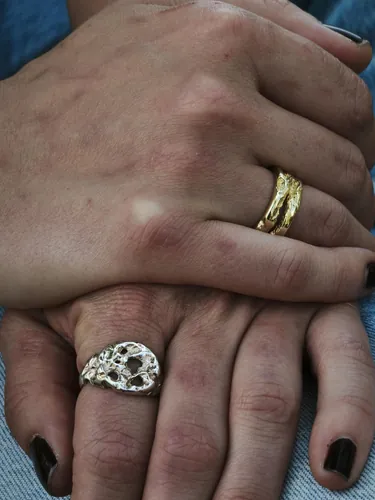
The two rings you wear together also matter. If you pair a sterling band with a gold engagement ring, the silver will show its age sooner, because solid gold resists wear and tarnish better. For a closer look at plated versus solid metal, read our guide to gold plated versus solid gold rings.
Why sterling silver tarnishes
Silver tarnishes because of sulfur compounds in the air. The Canadian Conservation Institute describes the dark layer as silver sulphide and says a thin film can quickly destroy the surface luster. Salts and oils from skin can also mark silver, according to that note.
The institute recommends sealed, tarnish-inhibiting storage to limit exposure to tarnishing gases. A closed container follows that advice.
Product choice matters. The note says general metal polishes are more abrasive than silver polishes. It adds that the ammonia in many commercial polishes can dissolve copper, and that residue left in crevices can turn green. A textured band has crevices, so rinse and dry it fully after cleaning.
Polishing has a cost. Each polish or chemical tarnish removal takes away some of the underlying silver along with the tarnish. Clean the band when it needs it and no more often.
Who should choose sterling
- Choose sterling silver if you work at a desk or want a first band at a lower price.
- Choose sterling silver if you want a second band for days you would rather not risk the main one.
- Choose solid gold if your hands do daily physical work and you want the surface to hold up longer.
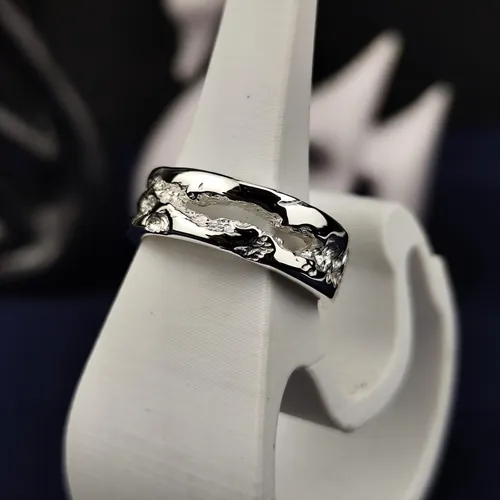
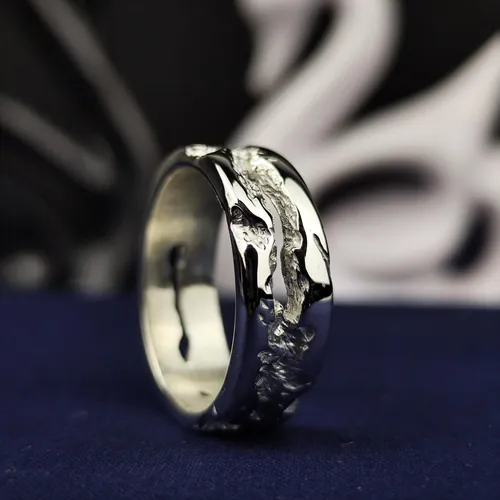
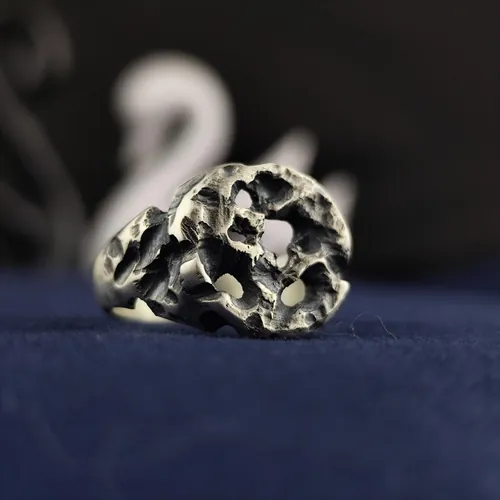
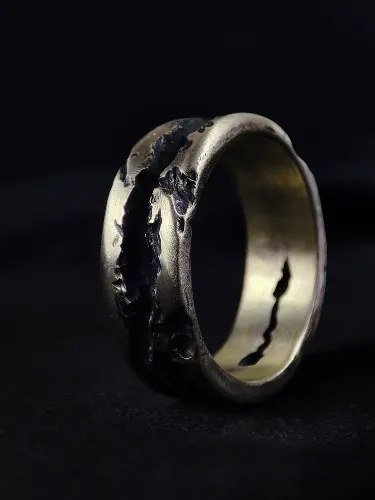
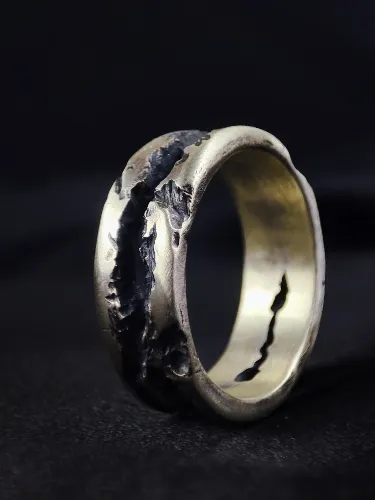
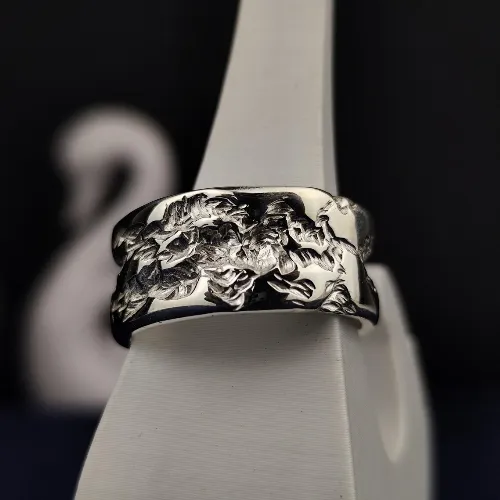
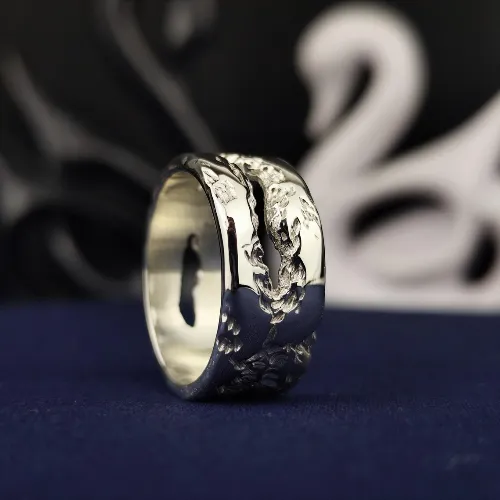
Our rustic rings collection covers textured and oxidized finishes. Two places to start are the Rustic Silver Band with Oxidized Fissure Texture and the Handmade Rustic Sterling Silver Ring.
If you want gold, we make solid 10K, 14K and 18K rings, with options that differ by product. You can wear sterling now and add a gold band later. Our how personalization works page explains how a custom order runs.
What to check before ordering
- Confirm the band is solid sterling with a 925 stamp, not a plated finish.
- Ask for the width and thickness in writing.
- Choose the surface: mirror polish, texture or oxidized.
- Ask whether the band has a comfort fit profile, and what that means for the inside surface.
- Confirm the size. Our ring size guide and the walkthrough on finding your ring size at home cover how to measure.
- Read the return terms for personalized items.
Personalized items are non-refundable, but eligible ring-size exchanges are covered. Our Lifetime Craftsmanship Guarantee covers manufacturing defects. It does not cover accidental damage or the wear of plating.
How we make our sterling bands
We make rings to order in our workshop in Ankara, Turkey. Each one is cast individually, then engraved and finished by hand. You can send initials, a name, a date, a logo, a sketch or a reference image. The design is custom-drawn or adapted for you. We then send a digital proof for approval, usually within 24 to 48 hours.
Production takes 1 to 2 business days after you approve the proof. Shipping is free and tracked, and delivery takes 5 to 7 business days. US orders arrive duties paid. Nothing is made before you approve.
Browse the rustic rings collection, send us your initials or a sketch, and review the proof.
Sources and further reading
Frequently asked questions
How long does a sterling silver wedding band last?
It depends on wear and care. The Canadian Conservation Institute notes that each polish removes some silver, so a band you clean only when needed keeps more metal. Air darkens silver over time and skin oils mark it.
Is sterling silver the same as silver plated?
No. The FTC says sterling is 92.5% pure silver, while silver plate is a layer of silver applied to a base metal. Plating eventually wears away depending on wear and thickness, but sterling is one alloy throughout.
How often should I clean a sterling silver band?
Only when it needs it. The Canadian Conservation Institute says each polishing takes away some silver, and it warns that general metal polishes are more abrasive than silver polishes. Use a soft cloth and rinse and dry the band fully.
How thick should a sterling wedding band be?
We cannot give one figure, because it depends on the design. Ask the maker for the width and thickness in writing and compare bands on those numbers. With us, you review a digital proof before production starts.
Can I add a gold band later?
Yes. You can order a gold band at any time and keep the sterling one as a second ring. Our solid 10K, 14K and 18K options differ by product, so check the product page for the metals offered.
Keep reading
- Men's Sterling Silver Wedding Band Engraved: Checklist
- Sterling Silver Mens Wedding Band Comfort Fit: Buyer Checks
- Are Hammered Wedding Bands Durable? Metal Matters
Shop the collection: Rustic Rings.