Masonic Rings: Symbols, Meaning and How They Are Worn
By Burtay Eray Dinçel ·
A Masonic ring is a small, wearable record of a man’s place in the fraternity, and for many families it becomes a keepsake that outlives the wearer.
Where the symbols come from
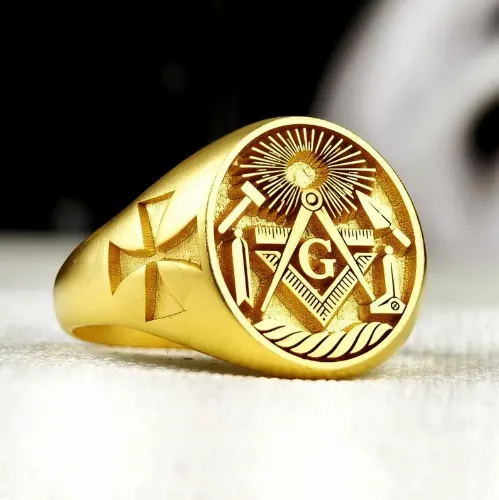
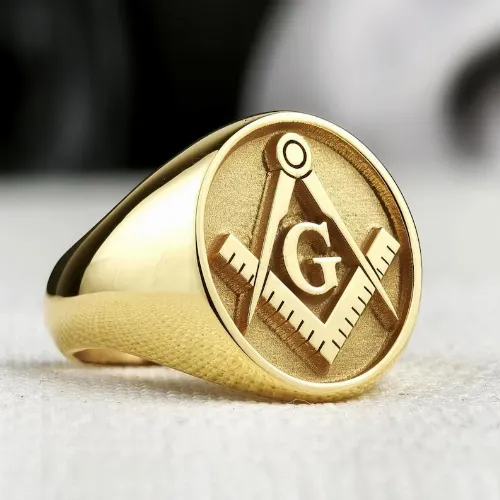
Many Masons date English Freemasonry to 1717, when the Grand Lodge was founded in England. The fraternity’s symbols come from the world of stonemasons, and the square and compasses is its most recognizable emblem. Nobody knows exactly when the pair was first used as a Masonic symbol, but the roots are thought to lie in medieval stonemasons’ guilds. The square stands for morality and the compasses for keeping one’s desires within bounds. These are the tools of a builder, used as lessons for living.
An 18th-century Masonic ring you can still see
Colonial Williamsburg holds a Masonic ring made in England between 1750 and 1775. It is a thin gold hoop with open-work Masonic symbols (a square, a compass, a star and a crescent sun) and is set with 24 small garnets. Early Masonic rings were not always broad, flat signets: on this one, the symbols and stones wrap around the hoop. The Victoria and Albert Museum records a similar English ring from the same period, with tiny set square, ruler, compasses, level and trowel on the bezel, and describes such rings as comparatively unusual.
The letter G
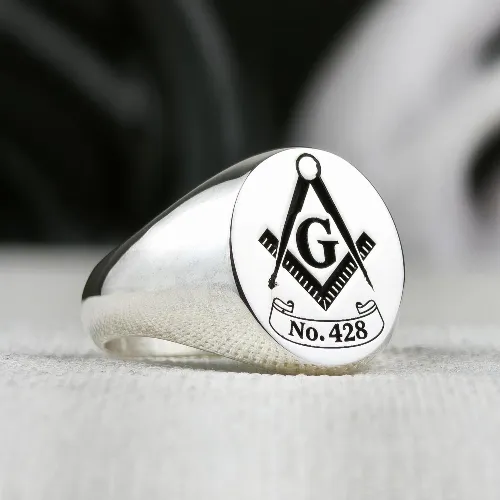
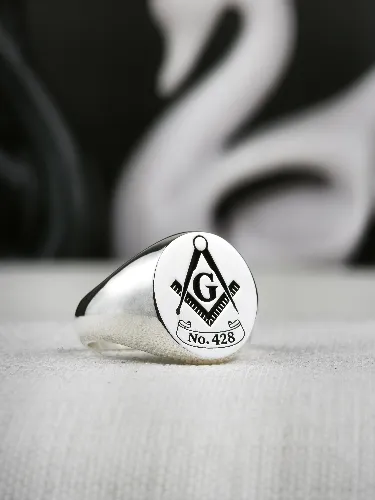
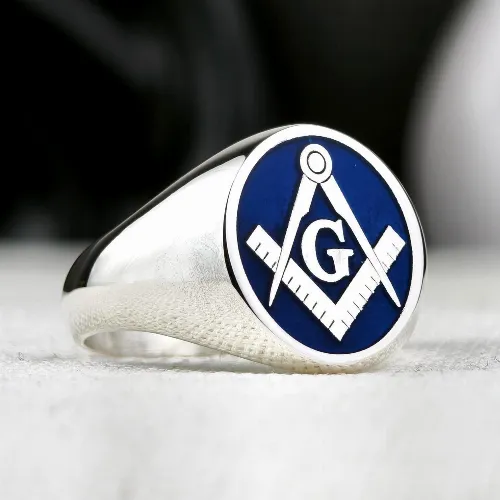
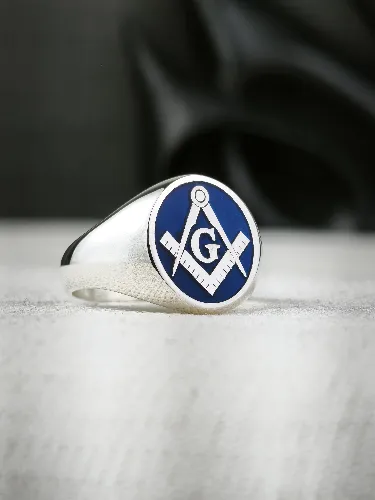
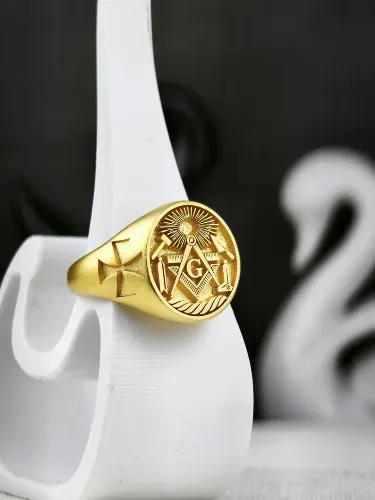
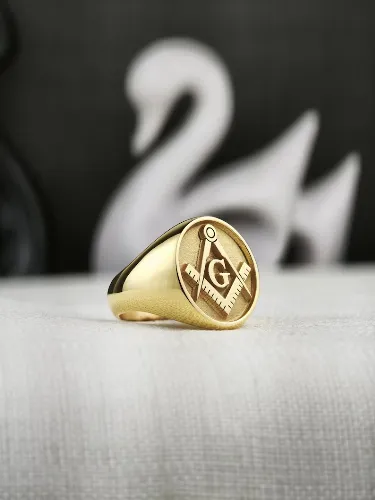
Many rings show a letter G in the middle of the square and compasses. It is usually read as Geometry, the foundation of the builder’s craft, or as God, the Great Architect of the Universe. The Museum of Freemasonry notes that the G is common in many countries but not in England, and that it became more common in the USA in the 1800s. So a ring with a G, and a ring without one, can both be fully traditional.
Other symbols you may see
| Symbol or detail | Where it is used |
|---|---|
| Square and compasses | The classic emblem for a Master Mason |
| Blue stone | Worn by members of the blue lodge |
| Red stone | Common with Royal Arch (4th degree) and Shriners |
| Triple tau | Royal Arch Chapter rings |
| Numbers such as 32 or 33 | Scottish Rite degrees |
| Euclid’s 47th Proposition | The Past Master’s emblem |
| Knights Templar emblems | York Rite members |
Color alone is not proof of anything. A red surface may be garnet, resin or enamel, and a black surface may be onyx or enamel, so look at color, material and degree markings separately. Customs also differ by jurisdiction, and some official degree rings follow strict rules: the Scottish Rite Northern Masonic Jurisdiction, for example, does not allow stones or other decoration to be added to its official 14th-degree ring. If you are making a ring for a specific degree, ask your lodge or body first.
Who wears one, and when
Masonic rings are generally worn by Master Masons, after they have been raised to the third degree. Members of appendant bodies such as the York Rite, Scottish Rite and Shriners often wear rings with their own emblems. Rules and customs vary between Grand Lodges, so a member should ask his lodge if he is unsure.
Points in or points out?
There is no single rule, and Grand Lodges have generally not regulated it. Many Masons wear the compasses with the points toward themselves, as a private reminder of their obligations. Others wear them pointing outward, so that the emblem reads correctly to the person looking at it, and so that the ring would stamp the right way round in wax. Some say the outward turn is for a Worshipful Master or Past Master, while the Masonic Service Association of North America and several Grand Lodge handbooks leave both directions to the wearer. Official degree rings can have their own rules, such as a specified hand and finger. For a custom ring, we simply ask which direction you want.
A ring that carries a family story
Many Masons wear a ring to honor a father’s or grandfather’s membership as much as their own. A custom signet can hold the emblem on the face and, inside the band, a name, a date or a lodge number. Those small details turn a ring into something a son can inherit.
If you have inherited a Masonic ring
Before cleaning or resizing an old ring, photograph the face, both shoulders, any marks inside the band and any inscription. Note the previous owner’s name, a possible lodge number and the date, and keep the original box if there is one. The Museum of Freemasonry asks for a photograph and as much information as possible about the previous owner when it looks into an object. If the metal, stone or finish is unclear, decide on care only after that. See our care guide.
Choosing your Masonic signet
- Decide the central emblem: square and compasses with or without G, or your appendant body’s symbol.
- Decide the face shape and size for the finger you will wear it on. See how to choose a signet ring face size.
- Choose the metal. We make rings in sterling silver, with gold plated, gold vermeil or platinum plated finishes.
- Add engraving inside the band, such as initials, a date or a lodge number.
See our Masonic rings collection, and our guides to the meaning behind Masonic rings and choosing a custom Masonic ring.
Sources: Museum of Freemasonry, London; Art UK; Colonial Williamsburg; Victoria and Albert Museum; Wikipedia, Square and Compasses; Grand Lodge of Ohio; Scottish Rite NMJ; Masonic Service Association; History.com.
Frequently asked questions
What does the G on a Masonic ring mean?
It is usually read as Geometry, or as God, the Great Architect of the Universe. It appears on many rings but not on all of them.
Which way should the compasses point?
There is no single rule. Many Masons wear the points toward themselves, others outward, and many Grand Lodges leave it to the wearer.
Keep reading
- Master Mason Gift: What to Check Before Ordering a Ring
- How to Choose a Custom Masonic Ring: Symbols, Metals, Fit and Personalisation
- The Meaning Behind Masonic Rings: A Buyer’s Guide
Shop the collection: Masonic Rings.